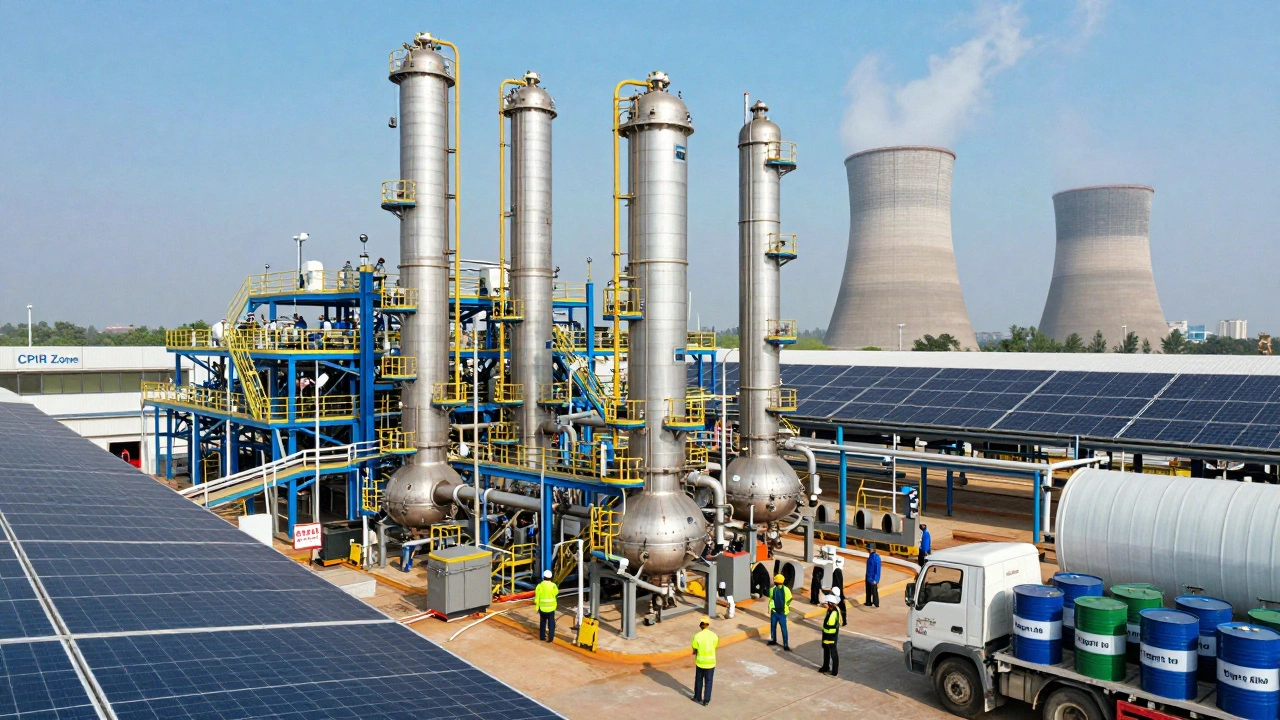
Chemical Manufacturing Cost Comparison Calculator
Cost Comparison Tool
Compare your manufacturing costs between India and China for chemical production. Input your specific parameters to see potential savings.
When you're running a chemical manufacturing business, every dollar counts. The question isn't just whether India is cheaper than China-it's whether it's cheaper enough to justify the shift. For many chemical producers, the answer isn't black and white. But the data, real-world examples, and shifting policies tell a clear story: India is closing the gap, and in some areas, it's already ahead.
Labour Costs: The Biggest Difference
In China, factory workers in coastal cities like Shanghai or Guangzhou earn an average of $6.50 per hour. In India, a skilled chemical operator in Gujarat or Tamil Nadu earns about $1.80 per hour. That’s a 72% difference. But here’s the catch: productivity isn’t the same. Chinese workers, on average, produce 2.3 times more output per hour due to automation, better training systems, and decades of industrial discipline. In India, you might save on wages, but you’ll often need more people to get the same output. For high-volume, low-complexity chemical processes like detergent production, India wins. For precision chemical synthesis requiring tight tolerances, China still has the edge.Energy and Utilities: India’s Hidden Advantage
Natural gas, electricity, and water aren’t just costs-they’re lifelines in chemical manufacturing. In China, industrial electricity costs about $0.11 per kWh. In India, it’s $0.07. For a plant running 24/7, that’s $120,000 a year saved per megawatt of capacity. India’s government also subsidizes water usage for chemical units under the Chemicals and Petrochemicals Investment Region (CPIR) scheme. China phased out most energy subsidies in 2022 to meet carbon targets. Factories in Shandong now pay full market rates. In India, you can still get 30% off power for five years if you invest over $5 million in a designated manufacturing zone.Raw Material Access: Local vs Global
India is a top producer of key chemical feedstocks. It’s the world’s third-largest producer of soda ash, the fourth-largest in caustic soda, and a major exporter of paraxylene. If your chemical process uses these, sourcing locally cuts logistics costs by 40% compared to importing from China. But China dominates in rare chemical intermediates-things like specialty catalysts, high-purity solvents, and complex organic compounds. If your formula relies on those, you’ll still need to import from China, even if you manufacture in India. The real win? India’s domestic chemical industry grew 14% in 2025, and 78% of basic chemicals are now made locally. That’s up from 59% in 2020.Regulations and Compliance: Slower, But Simpler
China’s environmental rules are strict-and enforced with precision. A single chemical plant in Jiangsu can face fines of $2 million for a minor spill. India’s rules are looser, but that’s changing fast. The Central Pollution Control Board (CPCB) now requires real-time emission monitoring for all chemical plants over 500 tonnes per year. Penalties are rising, but enforcement is still patchy. The upside? Getting permits in India takes 60-90 days. In China, it takes 180-240. For a startup or small chemical manufacturer, that time savings means you can start earning sooner. In 2024, over 1,200 new chemical plants opened in India. Only 380 opened in China.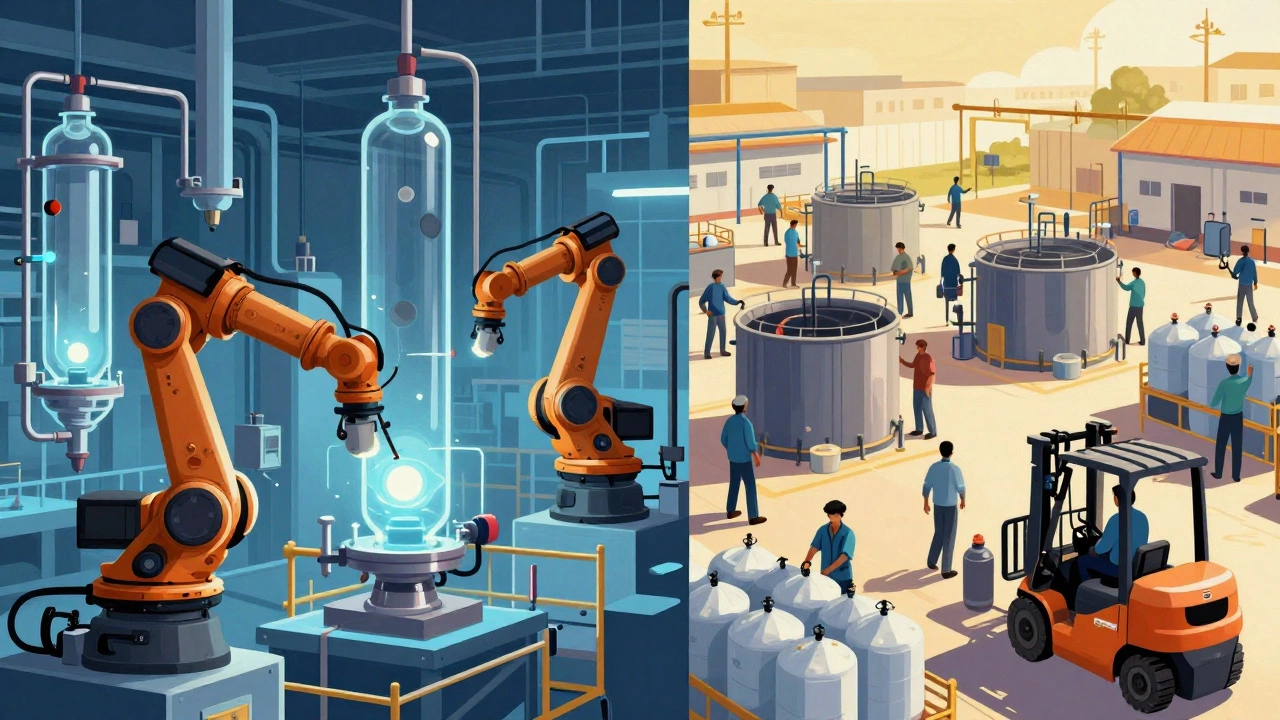
Infrastructure: Ports, Roads, and Power
China has the best logistics network on Earth. Its ports handle 40% of global container traffic. India? It’s improving fast. The Jawaharlal Nehru Port Trust (JNPT) now handles 4.2 million TEUs annually-up from 2.8 million in 2020. New dedicated freight corridors are cutting truck transit times by 30%. But if you need to ship bulk liquid chemicals to Europe or the U.S., China’s deep-sea ports and integrated logistics hubs still win. India’s advantage? Proximity to Africa and the Middle East. If your market is West Africa, Egypt, or Saudi Arabia, shipping from Mumbai or Chennai is 40% cheaper and 5 days faster than from Shanghai.Supply Chain Resilience: The Post-Pandemic Shift
After COVID, global buyers stopped trusting single-source supply chains. Companies that relied on China for 90% of their chemical inputs saw disruptions that cost millions. Now, many are building dual-sourcing models. India became the top alternative. In 2025, U.S. chemical imports from India jumped 37%. European demand rose 42%. Why? Because India doesn’t have the same geopolitical risks. It’s not part of any trade war. Its supply chain is more diversified. You can get sodium hypochlorite from Gujarat, phosphoric acid from Andhra, and chlorine from Odisha-all under one country’s regulatory umbrella.Government Incentives: India’s Aggressive Push
China doesn’t give out incentives anymore. India is handing them out like candy. Under the Production Linked Incentive (PLI) scheme for specialty chemicals, companies get 10% of their incremental sales as cash back for five years. If you invest $20 million in a new plant, you could get $4 million back over five years. There’s also a 100% tax holiday for new manufacturing units in special economic zones (SEZs) for the first 10 years. China’s last major incentive program ended in 2023. India’s are still active-and expanding.
Real-World Example: A Chlorine Plant in Gujarat
In 2023, a U.S.-based chemical firm moved its chlorine production from Zhejiang, China, to Dahej, Gujarat. Why? Here’s what they saved:- Labour: $1.2 million/year less
- Electricity: $310,000/year less
- Raw material logistics: $480,000/year less
- Permitting time: 8 months faster
- PLI incentive: $1.1 million over 5 years
When China Still Wins
Don’t write off China yet. If you need:- High-speed automation for batch reactors
- Ultra-pure reagents (99.99%+ purity)
- Just-in-time delivery to North America or Europe
- Access to 10,000+ trained chemical engineers
The Verdict: It Depends on Your Product
For bulk chemicals-acids, alkalis, solvents, basic polymers-India is cheaper. Faster. More flexible. And getting better every year. For specialty chemicals-pharmaceutical intermediates, high-performance catalysts, electronic-grade solvents-China still leads. But the gap is narrowing fast. India’s chemical R&D spending hit $1.8 billion in 2025. It’s up 56% from 2020. The smart move? Don’t choose one. Build in both. Use India for volume, China for precision. Let India handle your bulk supply. Let China handle your high-purity niche. That’s what the top 20 global chemical firms are doing now.Is manufacturing in India really cheaper than in China?
Yes, for bulk chemical production, India is cheaper-often by 30-50%-when you factor in labour, power, and government incentives. But for high-precision or high-tech chemical manufacturing, China still offers better efficiency and reliability. The cost advantage in India is strongest for products that don’t need extreme automation or ultra-pure inputs.
What chemicals are best made in India?
India excels at producing basic chemicals: caustic soda, soda ash, sulphuric acid, chlorine, and basic polymers like HDPE and PVC. It’s also strong in agrochemicals and dye intermediates. If your product uses locally available feedstocks like salt, limestone, or crude oil derivatives, India is ideal. Complex organic synthesis or high-purity solvents are still better handled in China or Europe.
How long does it take to set up a chemical plant in India?
With proper planning, you can get a chemical plant up and running in 12-18 months in India. Permitting takes 60-90 days if you’re in a designated manufacturing zone. Construction takes 8-12 months. In China, the same process takes 24-30 months due to stricter environmental reviews and bureaucratic delays.
Are there risks in moving manufacturing from China to India?
Yes. India’s infrastructure is improving but still inconsistent. Power outages happen in some regions. Skilled labour is harder to find than in China. Quality control systems aren’t as mature. There’s also more variability in supplier reliability. The solution? Start with a pilot line. Test your supply chain. Don’t fully relocate until you’ve validated performance over 6-12 months.
What government schemes support chemical manufacturing in India?
India offers the Production Linked Incentive (PLI) scheme for specialty chemicals, which gives 10% of incremental sales back for five years. There’s also a 100% tax holiday for 10 years in SEZs, subsidized power and water under CPIR zones, and fast-track environmental clearances for greenfield projects. These are active as of 2026 and are expanding.
If you're considering a shift, start with a small pilot. Set up a 10-tonne-per-day line in Gujarat or Tamil Nadu. Compare your actual costs against your China operation. You might be surprised how quickly India pays for itself.