Processing Unit Validation Checklist
Validation Results
Enter your processing details and click Validate
When you hear the term defined processing unit, it might sound like jargon - but in food manufacturing, it’s one of the most practical concepts you’ll ever need to understand. It’s not a fancy gadget or a high-tech robot. It’s a clear, repeatable step in food production that turns raw ingredients into a consistent, safe, and market-ready product. Think of it like a single gear in a machine: if it doesn’t turn right, the whole system jams.
What Exactly Is a Defined Processing Unit?
A defined processing unit is a single, measurable, and standardized operation within a food production line. Each unit has a specific purpose, controlled inputs, and predictable outputs. It’s not just any step - it’s a step that’s been documented, tested, and validated to ensure safety, quality, and efficiency.
For example, in a juice factory, one defined processing unit might be pasteurization at 72°C for 15 seconds. Another could be filtration through a 5-micron membrane. These aren’t guesses. They’re precise, repeatable actions backed by food safety standards like HACCP or ISO 22000.
Why does this matter? Because in food processing, consistency isn’t optional. If one batch of sauce is too thick and another too watery, customers notice. Regulators notice. And if a pathogen slips through because a step was skipped or poorly controlled, the consequences can be deadly.
How Defined Processing Units Work in Real Factories
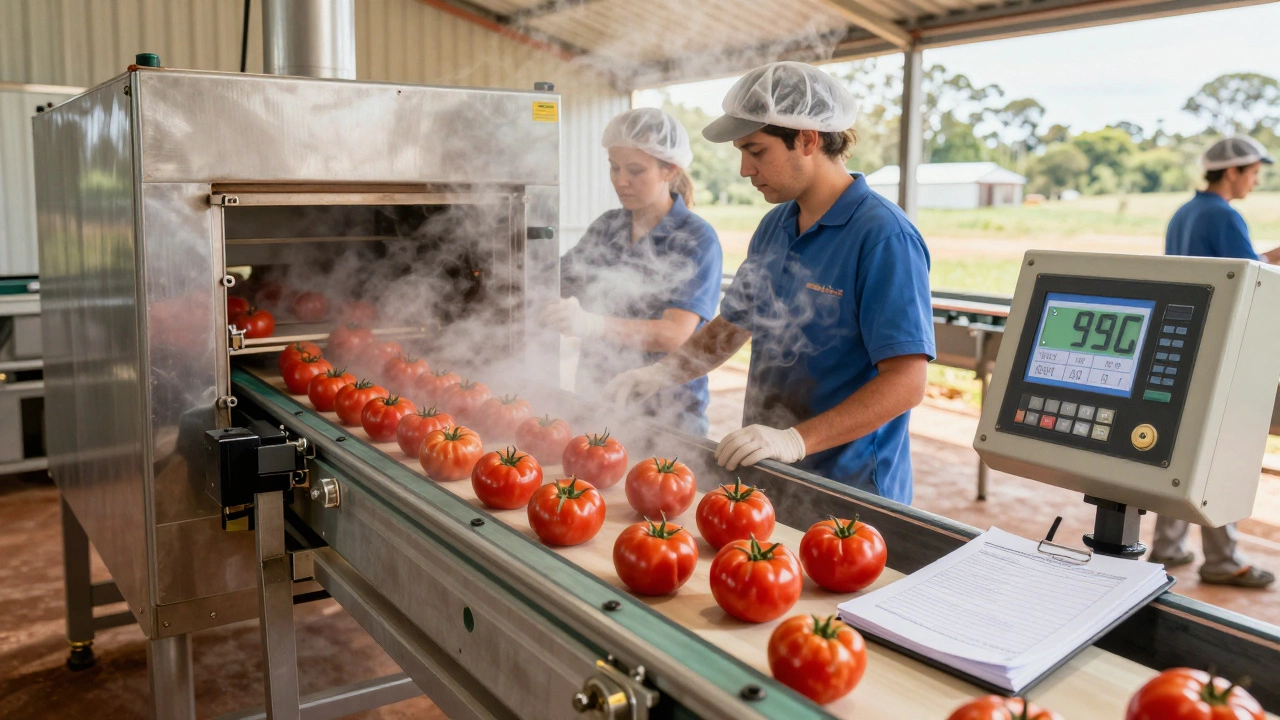
Let’s walk through a simple example: a small-scale canned tomato sauce plant in rural Queensland. The process isn’t complicated, but each step is a defined processing unit:
- Receiving and sorting tomatoes - visual inspection, removal of damaged fruit, weight verification.
- Washing and pre-cleaning - water spray at 0.5 bar pressure, 45-second cycle, validated by microbial swabs.
- Blanching - steam at 95°C for 90 seconds to inactivate enzymes and loosen skins.
- Peeling - mechanical abrasion with rotating brushes, followed by air blow-off.
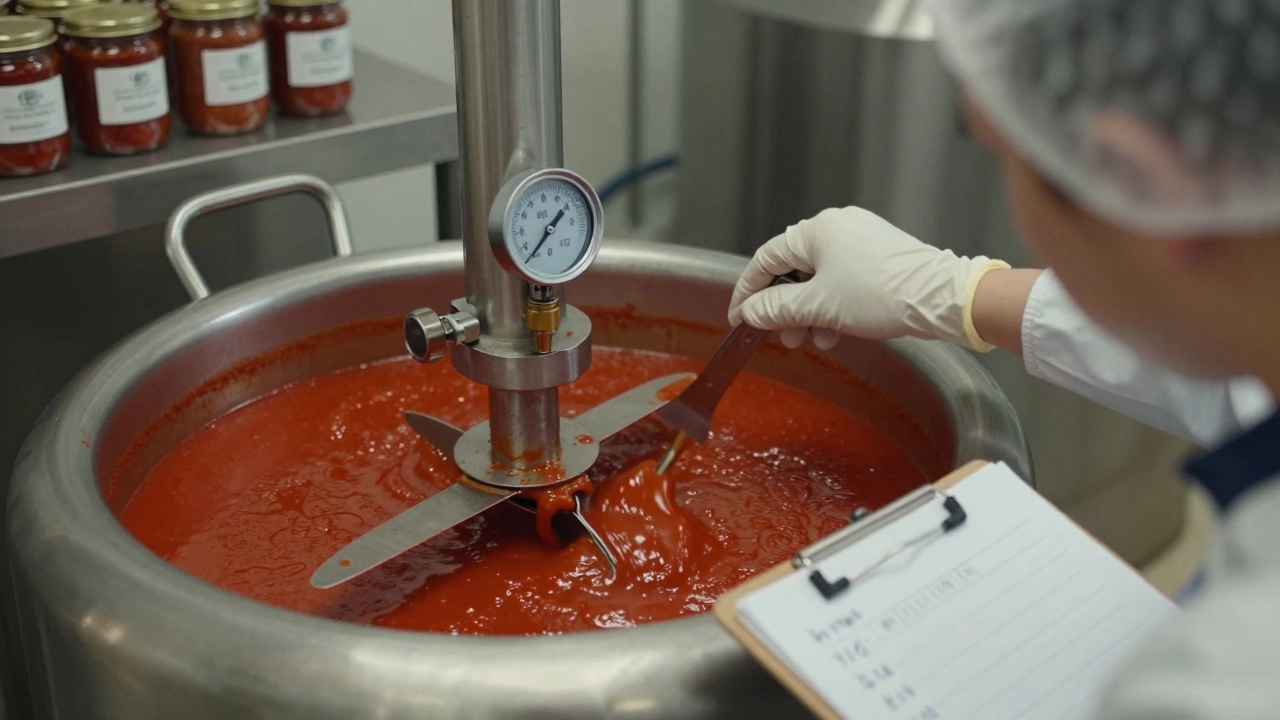
- Chopping and cooking - heated in stainless steel tanks to 85°C for 30 minutes with constant stirring.
- Adding ingredients - salt, citric acid, and basil measured by weight, not volume.
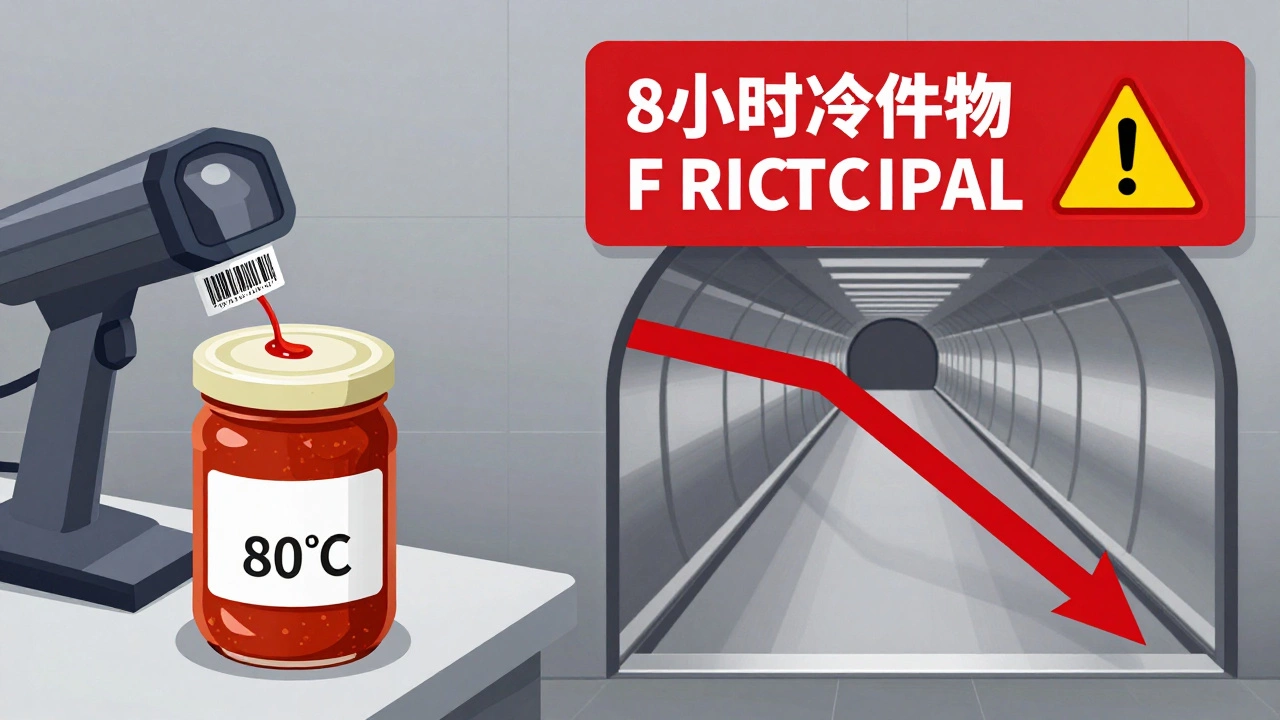
- Hot-filling into jars - product at 80°C, filled into sterilized jars, sealed within 10 seconds.
- Thermal processing - jars processed in retort at 121°C for 40 minutes to achieve commercial sterility.
- Cooling - gradual cooling from 121°C to 38°C over 60 minutes to prevent jar breakage.
- Labeling and packing - barcode scan, weight check, batch code stamped.
Each of these steps is a defined processing unit. They’re not just done - they’re measured, monitored, and recorded. Every temperature, every time, every weight. If the blanching time drops to 70 seconds? The system flags it. The batch gets quarantined. No exceptions.
Why Defined Units Are Non-Negotiable
Food safety isn’t about hoping for the best. It’s about controlling every variable. A defined processing unit eliminates guesswork. It turns subjective judgment into objective data.
Take the case of a 2023 recall in Australia. A small producer of ready-to-eat chicken salad had three cases of listeria. Investigation found that one step - chilling the cooked chicken from 60°C to 5°C - was skipped. The cooling took 8 hours instead of the required 2. That’s not a mistake. That’s a failure of a defined processing unit. No one had documented the cooling curve. No one had trained staff to monitor it. And no one had alarms set up.
That’s why the food industry relies on defined units. They’re the backbone of:
- Traceability - If a problem occurs, you can trace it back to a specific unit and time.
- Compliance - Regulators like FSANZ (Food Standards Australia New Zealand) require documented processing steps.
- Efficiency - Once a unit is defined, you can optimize it. Automate it. Scale it.
- Quality control - No more “it tasted fine last time.” You measure the pH, the viscosity, the microbial load.
Common Mistakes with Defined Processing Units
Even smart operators mess this up. Here are the three most common errors:
- Assuming “it’s always been done this way” is enough. Just because your uncle’s sauce recipe worked for 30 years doesn’t mean it meets modern food safety standards. Defined units need scientific validation - not tradition.
- Skipping documentation. If you don’t write it down, it didn’t happen. Temperature logs, time stamps, operator initials - they’re not busywork. They’re your legal shield.
- Ignoring change control. If you switch to a new blender, change suppliers, or adjust the flow rate - you’ve changed a processing unit. That triggers a reassessment. Many small businesses skip this. They shouldn’t.
One Melbourne-based snack producer learned this the hard way. They switched from sunflower oil to canola oil without retesting the frying unit. The new oil had a lower smoke point. The product started tasting off. Sales dropped 40% in two months. All because they didn’t treat the frying step as a defined processing unit with measurable parameters.
How to Build Your Own Defined Processing Units
If you’re running a small food business, here’s how to start:
- List every step from raw ingredient to final package.
- Ask: What’s the purpose? Why is this step here? Is it for safety? Texture? Shelf life?
- Define measurable inputs - temperature, time, pressure, weight, speed, concentration.
- Set acceptable ranges - not just “heat it up,” but “heat to 75°C ±2°C for 12 minutes.”
- Validate with testing - send samples to a lab. Test for pathogens, pH, moisture, texture.
- Document everything - use a simple logbook or digital system. Include who did it, when, and what the readings were.
- Train your team - if they don’t understand why the unit matters, they’ll cut corners.
There’s no need for expensive software. Even a printed checklist with a pen and clipboard works - as long as it’s followed every time.
The Bigger Picture: Defined Units and Modern Food Systems
Today’s food industry is built on scalability. Big brands need thousands of units to produce millions of units of product. But even the smallest producer benefits from this system.
Defined processing units let you:
- Apply for export certification
- Get insurance coverage
- Attract investors or partners
- Scale up without losing control
- React fast when something goes wrong
It’s not about being fancy. It’s about being reliable. And in food, reliability is the only thing that keeps customers coming back - and regulators off your back.
Final Thought: It’s Not About the Machine - It’s About the Method
A defined processing unit isn’t a piece of equipment. It’s a method. It’s a rule. It’s a promise: every time, the same result.
That’s why the best food factories don’t spend their money on the flashiest machines. They spend it on training, documentation, and discipline. Because the real innovation isn’t in the hardware - it’s in the consistency of the process.
Is a defined processing unit the same as a food processing machine?
No. A food processing machine is hardware - like a mixer, filler, or pasteurizer. A defined processing unit is the specific, controlled procedure you run on that machine. For example, the machine might be a blender. The defined unit is: "Blend at 800 RPM for 45 seconds, until particle size is under 2 mm, verified by sieve test." The machine enables the unit - but the unit is the rule.
Do small food businesses need defined processing units?
Yes - especially small businesses. Regulators don’t care if you’re big or small. If you sell food, you must follow food safety rules. Defined processing units are how you prove you’re doing it right. Many small producers skip this, then get shut down during inspections. Documenting your steps isn’t paperwork - it’s your protection.
Can I use defined processing units for artisanal or handmade products?
Absolutely. Even handmade jams, fermented sauces, or small-batch breads need defined units. For example: "Ferment dough at 22°C for 18 hours, then bake at 230°C for 25 minutes until internal temp reaches 93°C." These aren’t robotic steps - they’re science-based controls that ensure safety and quality, even in handmade production.
What happens if I don’t define my processing units?
You risk contamination, recalls, shutdowns, or legal action. In Australia, FSANZ can inspect your facility and demand proof of control. If you can’t show documented, measurable steps for each stage of production, you’re not compliant. Insurance companies may also refuse claims if you haven’t followed recognized food safety practices. It’s not about being perfect - it’s about being accountable.
Where can I find templates or examples for defined processing units?
Food Standards Australia New Zealand (FSANZ) offers free guidance documents for small producers. The Australian Government’s Department of Agriculture also provides templates for HACCP plans. Local food industry associations often have workshops. Start with your local council’s food safety officer - they’re there to help, not to penalize.