Plastic Selection Calculator
What's Your Application?
When you’re choosing plastic for a product, you’re not just picking a material-you’re picking performance, durability, and cost. Not all plastics are created equal. Some bend under pressure. Others crack in the cold. A few can handle extreme heat, chemicals, and wear for decades. So what’s the highest quality plastic? It depends on what you need it to do. But if you’re building something that must last, perform under stress, or survive harsh environments, there are clear leaders in the field.
What Makes a Plastic ‘High Quality’?
Quality in plastic isn’t about shine or price. It’s about how well it holds up under real-world conditions. High-quality plastics maintain their shape, strength, and function when exposed to heat, chemicals, UV light, or mechanical stress. They don’t warp, crack, or degrade quickly. Manufacturers don’t choose them because they’re trendy-they choose them because they reduce failures, lower warranty costs, and extend product life.
Think of it like choosing steel for a bridge versus plywood. One gives you decades of service. The other might last a season. The same logic applies to plastics. The best materials are engineered, not just molded.
Top Contenders for Highest Quality Plastic
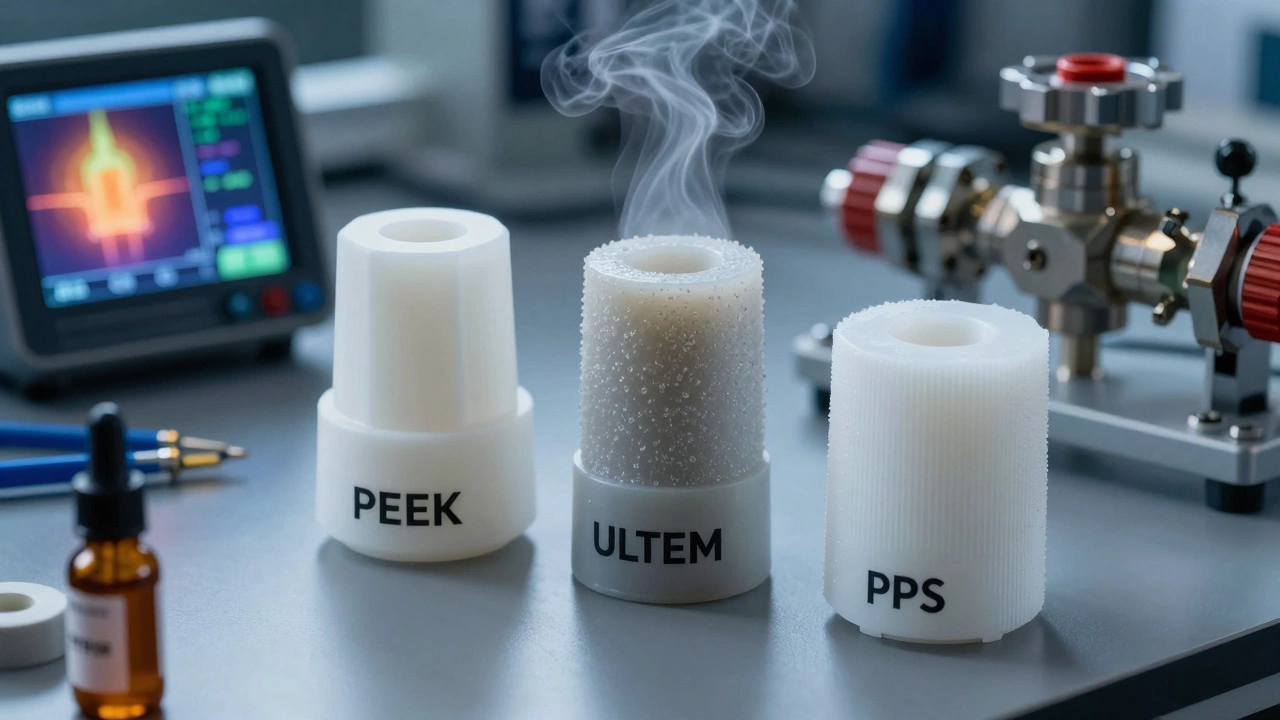
There are three plastics that consistently outperform others in demanding industrial and medical applications: PEEK, ULTEM, and PPS.
PEEK (Polyetheretherketone) is the gold standard. It’s used in aerospace, surgical implants, and high-pressure valves. It can handle continuous temperatures up to 260°C (500°F), resists nearly all chemicals, and has excellent mechanical strength even at high heat. It’s also biocompatible, which is why it’s used in spinal implants and dental tools. PEEK doesn’t melt easily-it degrades only above 500°C. That’s not just strong; it’s exceptional.
ULTEM (Polyetherimide) is another top performer. Made by SABIC, it’s often used in automotive under-the-hood parts, electrical connectors, and food processing equipment. It holds up to 170°C continuously and has outstanding flame resistance without added chemicals. ULTEM is also transparent in its natural form, which makes it useful for lenses and windows in high-temp environments. It’s not as expensive as PEEK, but it still delivers near-industrial-grade performance.
PPS (Polyphenylene Sulfide) is the quiet workhorse. It’s used in pump components, bearings, and electrical housings. It resists solvents, acids, and high temperatures up to 220°C. PPS is rigid, dimensionally stable, and doesn’t absorb moisture like many other plastics. It’s cheaper than PEEK but still outperforms standard nylons and acetal in harsh conditions.
Why Not Nylon, ABS, or Polycarbonate?
These are common plastics-but they’re not in the same league. Nylon absorbs water, which makes it swell and weaken. ABS softens around 100°C and becomes brittle in cold weather. Polycarbonate is tough and clear, but it degrades under UV exposure and scratches easily. All three are fine for consumer products, phone cases, or toy parts. But if you’re making a part that runs inside a jet engine, a chemical reactor, or a medical device sterilized with steam, they’ll fail.
Real-world example: A manufacturer in Brisbane switched from polycarbonate to ULTEM for a part that sits on a commercial coffee machine’s boiler. The old part cracked after six months. The new ULTEM part has been running for over four years without a single failure. That’s the difference quality makes.

Cost vs. Value: Is High-Quality Plastic Worth It?
Yes. PEEK costs 10 to 20 times more than ABS per kilogram. But if you’re making 10,000 parts a year, and one out of every 50 fails, you’re spending more on returns, downtime, and repairs than you’d save by using cheaper plastic. High-quality plastics reduce scrap rates, lower warranty claims, and cut maintenance costs. In industrial settings, a single part failure can shut down a production line. That costs thousands per hour.
One medical device maker in Germany replaced a nylon gear with PEEK in a surgical robot. The gear lasted 18 months before failing. The PEEK version is still running after seven years. They didn’t just buy a part-they bought reliability.
How to Choose the Right High-Quality Plastic
Here’s a simple decision guide:
- What’s the max temperature? If over 150°C, skip ABS and polycarbonate. Go for ULTEM or PEEK.
- Will it touch chemicals? Acids, solvents, or fuels? PEEK and PPS handle them best. Nylon and ABS will swell or crack.
- Does it need to be strong under load? PEEK has the highest tensile strength among common engineering plastics. PPS is stiffer but less tough.
- Is it for medical or food use? Only PEEK and certain grades of ULTEM are FDA-compliant and sterilizable.
- How many parts will you make? If it’s more than 5,000 units, the higher material cost pays for itself in reliability.
Where to Source High-Quality Plastics
Don’t buy from generic plastic suppliers. Look for companies that specialize in engineering resins. Major suppliers include:
- Victrex - the original maker of PEEK
- SABIC - producer of ULTEM
- Toray - offers high-grade PPS and other specialty polymers
- Evonik - supplies high-purity grades for medical and aerospace
These companies provide material data sheets with real test results-not marketing claims. Always ask for the TDS (Technical Data Sheet) and check the test conditions. A claim like “heat resistant to 200°C” means nothing unless you know if it’s short-term or continuous exposure.

Common Mistakes Manufacturers Make
Even experienced teams mess up. Here are the top three errors:
- Choosing based on appearance - Clear plastic isn’t stronger. White isn’t purer. Color doesn’t indicate quality.
- Ignoring moisture absorption - Many plastics absorb water during storage. PEEK and PPS are low-absorption, but nylon needs drying before molding. Skip this step, and your parts crack.
- Assuming all grades are the same - PEEK comes in unfilled, carbon-fiber reinforced, glass-filled, and medical-grade. Each has different strength, stiffness, and cost. Using the wrong grade can lead to failure.
One Australian manufacturer ordered PEEK for a valve seat but didn’t specify the grade. They got unfilled PEEK, which deformed under pressure. They switched to carbon-fiber reinforced PEEK and solved the issue. The material was the same-just the grade was wrong.
Future Trends in High-Quality Plastics
Engineers are pushing boundaries. New versions of PEEK now include graphene additives for better thermal conductivity. ULTEM is being modified to be more recyclable without losing performance. There’s also growing demand for bio-based engineering plastics-though they’re still early in development and not yet at the performance level of PEEK or PPS.
One thing’s certain: as machines get smaller, hotter, and more precise, the need for high-performance plastics will only grow. The cheapest plastic isn’t the cheapest anymore. The most reliable one is.
Is PEEK the best plastic for all applications?
No. PEEK is the highest-performing plastic for extreme conditions-high heat, chemicals, and mechanical stress-but it’s overkill for everyday uses. For indoor, low-stress parts, ABS or polycarbonate are fine. PEEK is for mission-critical applications where failure isn’t an option.
Can high-quality plastics be recycled?
Yes, but not easily. PEEK, ULTEM, and PPS are thermoplastics, so they can technically be re-melted. However, their high processing temperatures and degradation risks make recycling expensive and rare. Most industrial users reuse scrap internally during molding, but post-consumer recycling is limited. New bio-based and easier-to-recycle grades are in development, but they’re not mainstream yet.
How do I know if a plastic supplier is reliable?
Ask for the Technical Data Sheet (TDS) and Material Safety Data Sheet (MSDS). Check if they specify test standards like ISO or ASTM. Reputable suppliers will list exact values-like tensile strength at 23°C or heat deflection temperature-not vague terms like “high performance.” Avoid suppliers who can’t or won’t provide these documents.
Are there cheaper alternatives to PEEK?
Yes. PPS and ULTEM offer 80-90% of PEEK’s performance at 40-60% of the cost. If your application doesn’t need continuous 260°C resistance, PPS or ULTEM are excellent alternatives. Many manufacturers use them successfully in automotive, industrial, and medical devices.
Does color affect the quality of the plastic?
No. Color comes from pigments or dyes added during processing. It doesn’t change the base polymer’s strength or heat resistance. But some pigments can reduce UV stability or interfere with sterilization. Always check with the supplier if you’re adding color to medical or outdoor-grade plastics.
Final Thought: Quality Isn’t an Expense-It’s Insurance
Choosing the highest quality plastic isn’t about spending more. It’s about avoiding failure. In manufacturing, a single part that breaks can cost more than a thousand cheap ones. The best plastic isn’t the one that looks the nicest or costs the least. It’s the one that keeps your machine running, your product safe, and your reputation intact.