
TSMC Investment Feasibility Calculator
Estimate your potential returns and tax implications for investing in TSMC from India under the Liberalised Remittance Scheme (LRS).
Analysis Result
You see the news headlines about TSMC building fabs in Arizona and expanding its global footprint. You know they are the world's largest contract chipmaker. The question on your mind is simple: Can you, as an individual investor sitting in Mumbai, Delhi, or Bangalore, put your money into this tech giant?
The short answer is yes. But it isn't as simple as clicking 'Buy' on Zerodha or Groww like you would with Reliance Industries or Tata Motors. Investing in foreign stocks requires navigating a specific set of rules under the Liberalised Remittance Scheme (LRS) and choosing the right brokerage platform.
Understanding the Investment Route: Direct vs. Indirect
Before you transfer any rupees, you need to understand how TSMC trades. TSMC is listed on the Taiwan Stock Exchange under the ticker symbol 2330.TW. However, most international investors do not buy directly in New Taiwan Dollars. Instead, they access the company through American Depositary Receipts (ADRs) or Global Depository Receipts (GDRs).
As of mid-2026, TSMC has expanded its accessibility through various depository structures. For an Indian resident, there are two primary ways to get exposure:
- Direct Equity Purchase: Buying shares through a broker that offers international trading services. This usually involves buying the ADR if available on a US exchange, or accessing the Taiwan market directly via a specialized platform.
- Indirect Exposure via ETFs: Buying Exchange Traded Funds (ETFs) that hold TSMC as a major component. This is often easier for beginners who don't want to manage currency conversion fees or complex tax forms for foreign capital gains.
If you want pure ownership of TSMC, the direct route is the one we will focus on. It requires an account with a broker that supports cross-border transactions.
The Golden Ticket: Liberalised Remittance Scheme (LRS)
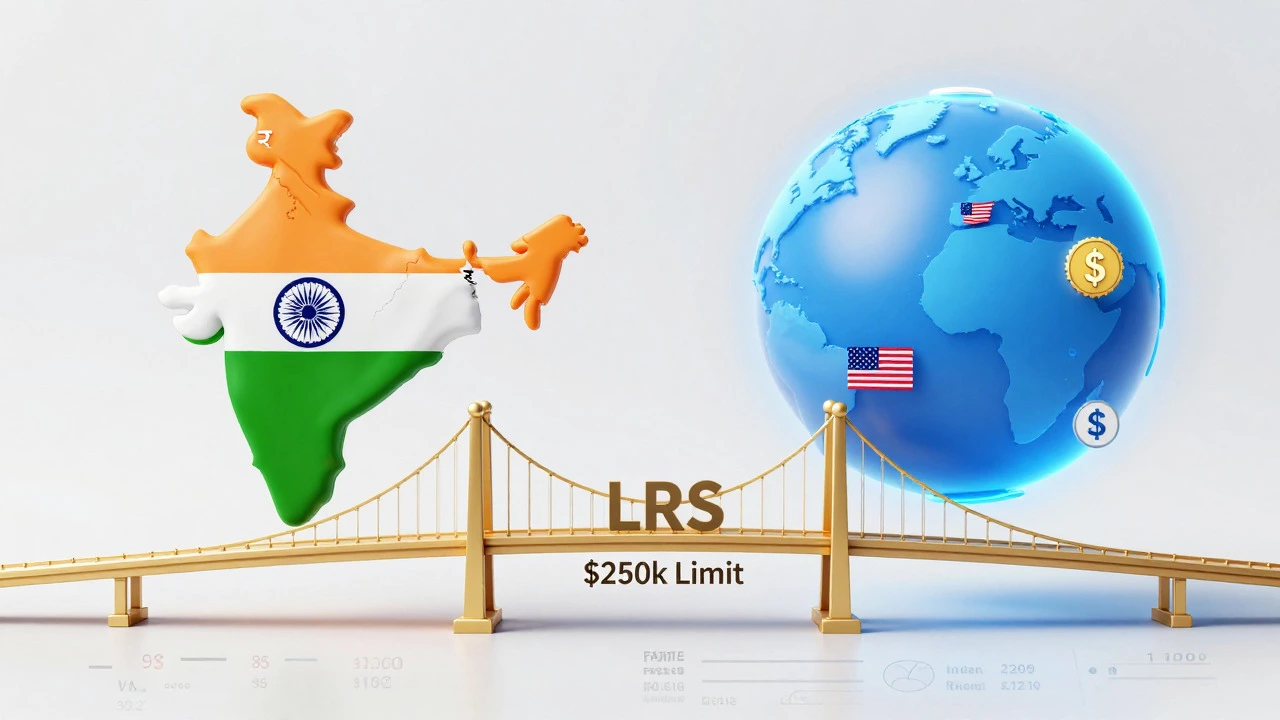
To send money out of India for investments, you rely on the Reserve Bank of India's (RBI) Liberalised Remittance Scheme. Think of LRS as your personal quota for sending money abroad for permissible current or capital account transactions.
Here are the hard rules you must follow:
- Limit: An individual can remit up to $250,000 USD per financial year (April to March). This limit applies to all outward remittances combined-whether for education, travel, gifting, or investing.
- Eligibility: Only resident individuals can use LRS. Minors can also remit funds through their guardians, but the limit is shared within the family unit in some interpretations, so check with your CA.
- Taxation: Any income earned from these investments (dividends, interest, capital gains) is taxable in India. You must report it in your Income Tax Return (ITR).
Crucially, when you invest in TSMC, you are converting INR to USD (or TWD). Your bank will charge a spread on this conversion, and your broker may charge additional fees. Factor this into your expected returns. If the dollar strengthens against the rupee, your effective return goes up. If the rupee strengthens, your returns drop even if TSMC's stock price stays flat.
Choosing the Right Brokerage Platform
This is where many Indian investors get stuck. Your local domestic broker cannot execute trades on the Taiwan Stock Exchange or NASDAQ. You need a bridge.
There are three types of platforms popular among Indian investors in 2026:
| Platform Type | Examples | Pros | Cons |
|---|---|---|---|
| Global Brokers with Indian Onboarding | Interactive Brokers, Charles Schwab | Low fees, direct market access, regulatory safety | Complex interface, higher minimum deposits sometimes required |
| Indian Fintech Aggregators | Vested Finance, INDmoney, Kuvera | User-friendly UI, seamless INR funding, good customer support | Higher management fees, limited asset classes |
| Offshore Entities | Zoho Markets (via Seychelles), others | Access to hundreds of markets | Regulatory ambiguity, potential RBI compliance risks |
For most retail investors, starting with an Indian fintech aggregator like Vested or INDmoney is the smoothest experience. They handle the KYC, the fund transfer via LRS, and the currency conversion. However, for larger portfolios, Interactive Brokers remains the gold standard due to its transparency and low commission rates. Just ensure your chosen platform is compliant with current RBI guidelines regarding virtual digital assets and foreign equity.
Step-by-Step: How to Buy TSMC Shares
Let’s walk through the actual process. Assuming you have chosen a compliant broker:
- Complete KYC: Submit your PAN card, Aadhaar, and proof of address. Most platforms now offer paperless KYC linked to your banking details.
- Fund Your Account: Initiate a transfer from your Indian bank account to your broker’s designated NRE/NRO or current account. Select "Investment" as the purpose code. This triggers the LRS tracking.
- Currency Conversion: The broker will convert your INR to USD. Lock in the rate if possible. Note the date of conversion for tax purposes.
- Search the Ticker: Look for TSMC. Depending on the broker, you might see it as
TSM(if traded as an ADR on NYSE) or2330(on TWSE). Verify the exchange before buying. - Place the Order: Decide between a Market Order (buy immediately at current price) or Limit Order (buy only at a specific price). Given the volatility in semiconductor stocks, limit orders are safer.
- Settlement: Trades typically settle in T+1 or T+2 days depending on the market. Once settled, the shares appear in your portfolio.
Tax Implications: The Hidden Cost
Many investors forget about taxes until filing season. Here is what you need to know about holding TSMC as an Indian resident.
Capital Gains: If you sell TSMC shares at a profit, this is considered Long Term Capital Gain (LTCG) if held for more than 24 months (as per recent updates to foreign asset taxation) or Short Term Capital Gain (STCG) if sold sooner. STCG is added to your income slab. LTCG above ₹1.25 lakh is taxed at 12.5% (subject to current FY 2026-27 budget rules).
Dividends: TSMC pays dividends. These are taxed as "Income from Other Sources" in India. However, Taiwan may withhold tax at the source (typically 10-20%). You can claim a Foreign Tax Credit (FTC) in your Indian ITR to avoid double taxation, but you must file Form 67 by September 30th of the assessment year.
Reporting: If your total value of foreign assets exceeds certain thresholds, you must file Schedule FA in your ITR. Failure to disclose can lead to penalties under the Black Money Act. Keep all transaction statements from your broker handy.
Why TSMC? Understanding the Asset
Before committing capital, let’s look at why TSMC is a compelling pick. TSMC dominates the foundry market, producing over 60% of the world's advanced chips. They make the silicon brains for Apple, NVIDIA, AMD, and Qualcomm.
In 2025 and 2026, the demand for AI processors skyrocketed. TSMC’s exclusive early access to Extreme Ultraviolet (EUV) lithography machines from ASML gives them a moat that competitors like Samsung or Intel struggle to breach quickly. Their expansion into Arizona and Japan further secures supply chains for Western governments, reducing geopolitical risk premiums slightly.
However, remember that TSMC is heavily exposed to cyclical downturns in consumer electronics. If smartphone sales slump, TSMC feels it. Also, being based in Taiwan carries inherent geopolitical risks. Diversification is key. Don’t put your entire LRS limit into one semiconductor stock.
Risks Every Indian Investor Must Consider
International investing is not without pitfalls. Beyond the obvious market risk, consider these specific challenges:
- Currency Risk: A strong Rupee eats into your USD-denominated profits. In 2024-25, the INR depreciated significantly, boosting returns for Indian investors. But trends reverse. Hedge this by thinking long-term.
- Liquidity Risk: While TSMC is highly liquid, smaller international stocks might not be. Ensure you can exit if needed.
- Regulatory Changes: The RBI frequently updates LRS rules. In the past, restrictions were placed on crypto and certain OTC derivatives. Stay updated with notifications from the Department of Economic Affairs.
- Broker Risk: Choose regulated entities. Avoid unregulated offshore apps that promise easy access but lack legal recourse if they freeze your funds.
Alternatives to Direct TSMC Ownership
If the hassle of LRS, tax filings, and currency conversion seems too much, you have alternatives that provide similar exposure:
Semiconductor ETFs: You can buy ETFs like SMH (VanEck Semiconductor ETF) or SOXX (iShares Semiconductor ETF) through the same international brokers. These baskets include TSMC along with NVIDIA, Broadcom, and Texas Instruments. This reduces single-stock risk.
Indian Proxy Plays: Some Indian companies have strategic partnerships with global chipmakers or operate in the EMS (Electronics Manufacturing Services) space. While not a direct substitute for TSMC’s tech leadership, companies like Dixon Technologies or Kaynes Technology benefit from the broader electronics manufacturing boom in India. Check their annual reports for any joint ventures with global foundries.
Can I buy TSMC shares using my regular Indian demat account?
No. Standard Indian demat accounts (like those with CDSL or NSDL) only allow you to hold securities listed on Indian exchanges (NSE/BSE). To hold TSMC, you need an international brokerage account that provides a custodian service for foreign shares.
What is the minimum amount required to start investing in TSMC from India?
This depends on your broker. Some Indian aggregators allow you to start with as little as $10-$25 equivalent in INR. Traditional global brokers like Interactive Brokers may have no strict minimum deposit but charge per-trade commissions, making small trades inefficient. Always calculate the fee-to-investment ratio.
Do I need to pay tax on TSMC dividends in India?
Yes. Dividends received from foreign stocks are taxable in India under the head "Income from Other Sources." You must declare this income in your ITR. If Taiwan has already withheld tax, you can claim a Foreign Tax Credit to avoid paying tax twice on the same income.
Is it safe to send money abroad for investing under LRS?
Yes, provided you use authorized dealer banks and compliant brokers. The RBI regulates LRS strictly. Ensure you select the correct purpose code (usually for portfolio investment) when transferring funds. Keep records of all transactions for audit trails.
Can NRIs invest in TSMC differently than residents?
Yes. Non-Resident Indians (NRIs) have different rules. They can invest freely in global markets using their NRE/NRO accounts without the $250,000 LRS limit constraint that applies to residents. However, tax implications differ; for instance, LTCG rates for NRIs may vary based on DTAA (Double Taxation Avoidance Agreement) benefits.