Global Chemical Production Rankings Explorer
Explore how India compares to other global leaders in chemical production. Click on any bar or use the controls below for detailed insights.
You might have heard that India is the "pharmacy of the world" or a rising giant in agrochemicals. But where does it actually stand when we look at the entire chemical landscape? The short answer is impressive but nuanced. As of 2026, India ranks fifth globally in total chemical production by value. It sits behind the massive industrial engines of China, the United States, Germany, and Japan.
This position isn't just a number on a chart. It represents a sector worth over $350 billion, contributing roughly 4% to India's GDP and employing millions directly and indirectly. If you are looking to invest, partner, or simply understand the market dynamics, knowing *why* India holds this spot-and what sectors drive it-is crucial. Let’s break down the data, the key players, and the future trajectory of this vital industry.
The Big Picture: Who Are the Top Players?
To understand India’s rank, we need to see who is ahead. The global chemical industry is dominated by nations with deep infrastructure, vast raw material access, or high-value specialization. Here is how the top five generally stack up in terms of production volume and value:
| Rank | Country | Key Strengths | Production Value (Approx.) |
|---|---|---|---|
| 1 | China | Scale, basic chemicals, downstream integration | $1.1 Trillion+ |
| 2 | United States | Innovation, shale gas feedstock, specialty chemicals | $850 Billion+ |
| 3 | Germany | High-value specialties, engineering, sustainability | $270 Billion+ |
| 4 | Japan | Precision chemicals, electronics materials, R&D | $200 Billion+ |
| 5 | India | Cost competitiveness, pharma intermediates, agrochemicals | $350 Billion+ |
Note that while China leads in sheer volume, India punches above its weight in specific high-margin segments. The gap between India and the top three is significant in terms of total output, but the growth rate in India is often higher than in mature markets like Europe or Japan.
What Drives India’s #5 Position?
India didn’t reach this rank by accident. Several structural advantages have propelled the country into the top tier. Understanding these drivers helps explain why foreign investors keep pouring money into Indian chemical parks.
- Cost Competitiveness: Labor costs in India remain significantly lower than in China, Europe, or the US. This makes labor-intensive processes, such as formulation and packaging, highly attractive for global companies.
- Raw Material Access: India has abundant domestic sources of key raw materials like salt, limestone, and sulfur. While crude oil is imported, the refining capacity ensures a steady supply of petrochemical feedstocks.
- Regulatory Environment: Compared to the stringent and costly environmental regulations in the EU or US, India offers a more flexible regulatory framework, though this is tightening as sustainability becomes a priority.
- Skill Pool: The country produces thousands of chemical engineers and scientists annually. This talent pool supports everything from large-scale plant operations to niche R&D in specialty chemicals.
Key Sectors Fueling Growth
Not all chemicals are created equal. India’s strength lies in specific sub-sectors where it has achieved near-dominance or significant market share.
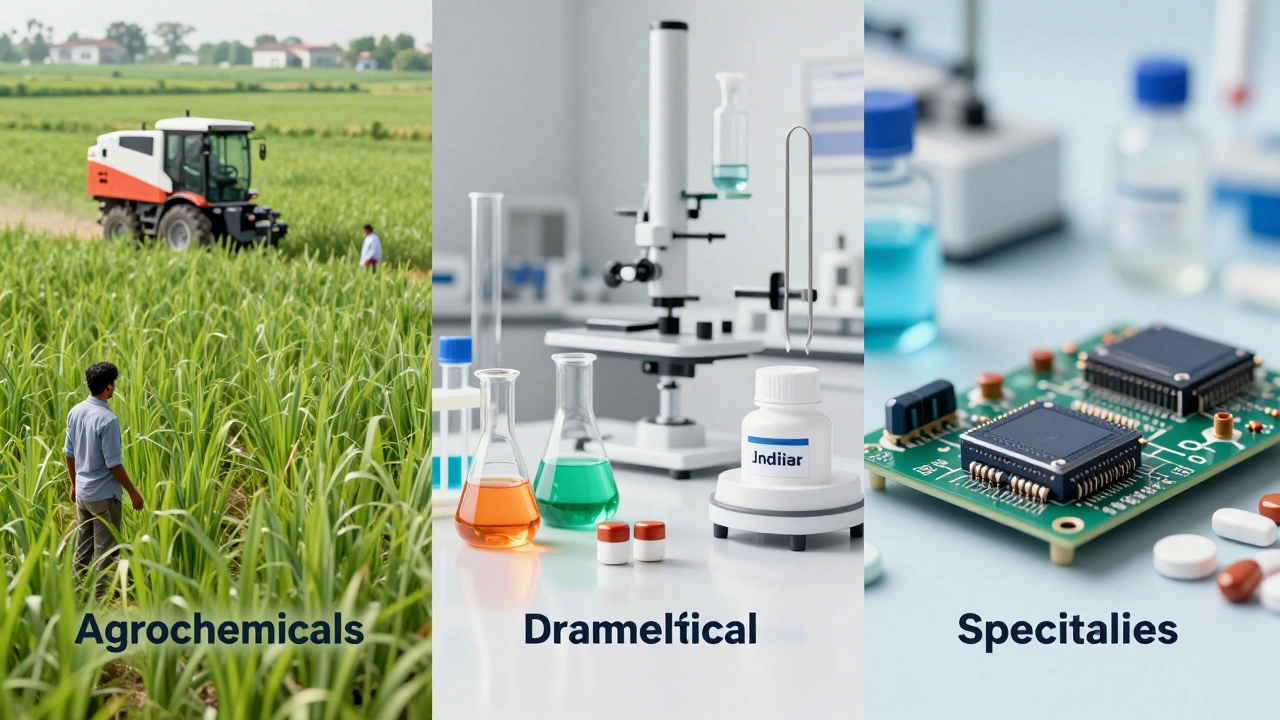
1. Agrochemicals
India is one of the largest producers of crop protection chemicals in the world. With a massive agricultural base, domestic demand is strong, but the real engine is exports. Indian manufacturers supply generic pesticides and fertilizers to markets in Latin America, Southeast Asia, and Africa. Companies like UPL and PI Industries are global leaders in this space.
2. Pharmaceuticals & Intermediates
While pharma manufacturing is often categorized separately, the chemical backbone is inseparable. India produces over 50% of the world’s generic vaccines and a significant portion of active pharmaceutical ingredients (APIs). The shift from importing APIs from China to producing them domestically has been a major policy focus, boosting the chemical sector’s value addition.
3. Specialty Chemicals
This is the fastest-growing segment. Unlike commodity chemicals (like soda ash or caustic soda), specialty chemicals are tailored for specific applications-think coatings, adhesives, water treatment, and electronics. India is becoming a preferred destination for contract manufacturing in this high-margin area due to its technical expertise and cost structure.
4. Petrochemicals
With integrated refineries and petrochemical complexes (such as those operated by Reliance Industries and Nayara Energy), India has built a robust downstream ecosystem. This includes plastics, fibers, and elastomers, which feed into the automobile, packaging, and construction industries.
Challenges Holding India Back from #1
If India is so competitive, why isn’t it number one? Several hurdles prevent it from overtaking giants like China or the US in the near term.
Infrastructure Gaps: While improving, logistics in India can still be inefficient. Transporting hazardous chemicals across long distances requires specialized infrastructure that is not yet ubiquitous. Port congestion and inland connectivity issues add to the cost and time.
Energy Costs: Electricity and natural gas prices in India are relatively high compared to competitors like the US (benefiting from shale gas) or Middle Eastern nations. Energy-intensive chemical processes suffer from this disadvantage.
Environmental Compliance: Incidents like the Visakhapatnam gas leak have highlighted safety concerns. Stricter enforcement of environmental norms is necessary for sustainable growth but may increase operational costs for smaller players in the short run.
Dependence on Imports: Despite being a top producer, India still imports certain critical raw materials and high-end specialty chemicals. Reducing this dependency through backward integration is a ongoing challenge.
The Future: Where Is India Headed?
The outlook for India’s chemical industry through 2030 is bullish. Government initiatives like the PLI (Production Linked Incentive) scheme for specialty chemicals and advanced chemistry cell batteries are designed to boost domestic manufacturing and reduce import reliance.
We are also seeing a trend called "China Plus One," where global companies diversify their supply chains away from China. India is the primary beneficiary of this shift. Multinational corporations are setting up new plants in India to serve both the domestic market and global export hubs.
Sustainability is another key driver. The push towards green chemicals, bio-based products, and circular economy models is opening new avenues for innovation. Indian startups and established firms are investing heavily in R&D to create eco-friendly alternatives to traditional petroleum-based chemicals.
Conclusion: A Rising Powerhouse
India’s rank as the fifth-largest chemical producer is a testament to its industrial resilience and strategic positioning. While it may not displace China or the US in total volume soon, its role in high-value segments like pharma intermediates, agrochemicals, and specialty chemicals is growing rapidly. For businesses and investors, India offers a unique blend of scale, skill, and cost advantage that is hard to match elsewhere.
Which country is the largest producer of chemicals in the world?
China is the largest producer of chemicals in the world, followed by the United States, Germany, Japan, and India. China's dominance is driven by its massive manufacturing base and low production costs.
How much does the chemical industry contribute to India's GDP?
The chemical industry contributes approximately 4% to India's Gross Domestic Product (GDP). It is also a major employer and exporter, playing a critical role in the country's economic stability.
What are the main challenges facing the Indian chemical industry?
Key challenges include high energy costs, logistical inefficiencies, environmental compliance pressures, and dependence on imported raw materials for certain specialty chemicals.
Is India a net exporter of chemicals?
Yes, India is a net exporter of many chemical categories, particularly agrochemicals, pharmaceutical intermediates, and dyes. However, it still imports significant volumes of basic petrochemicals and certain high-end specialty chemicals.
What government schemes support the chemical industry in India?
The Indian government offers several incentives, including the Production Linked Incentive (PLI) scheme for specialty chemicals and advanced chemistry cell batteries. Additionally, various state-level policies provide tax breaks and land subsidies for setting up chemical parks.