Manufacturing System Selector
Find Your Optimal Production Strategy
Enter your business parameters below to see which system fits best.
Pro Tip:
System Comparison Reference
| System | Volume | Variety | Cost/Unit | Flexibility |
|---|---|---|---|---|
| Mass Production | Very High | Low | Very Low | Low |
| Batch Production | Medium | Medium | Medium | Medium |
| Job Shop (Custom) | Low | High | High | High |
| Additive (3D Print) | Low-Med | Very High | Variable | Very High |
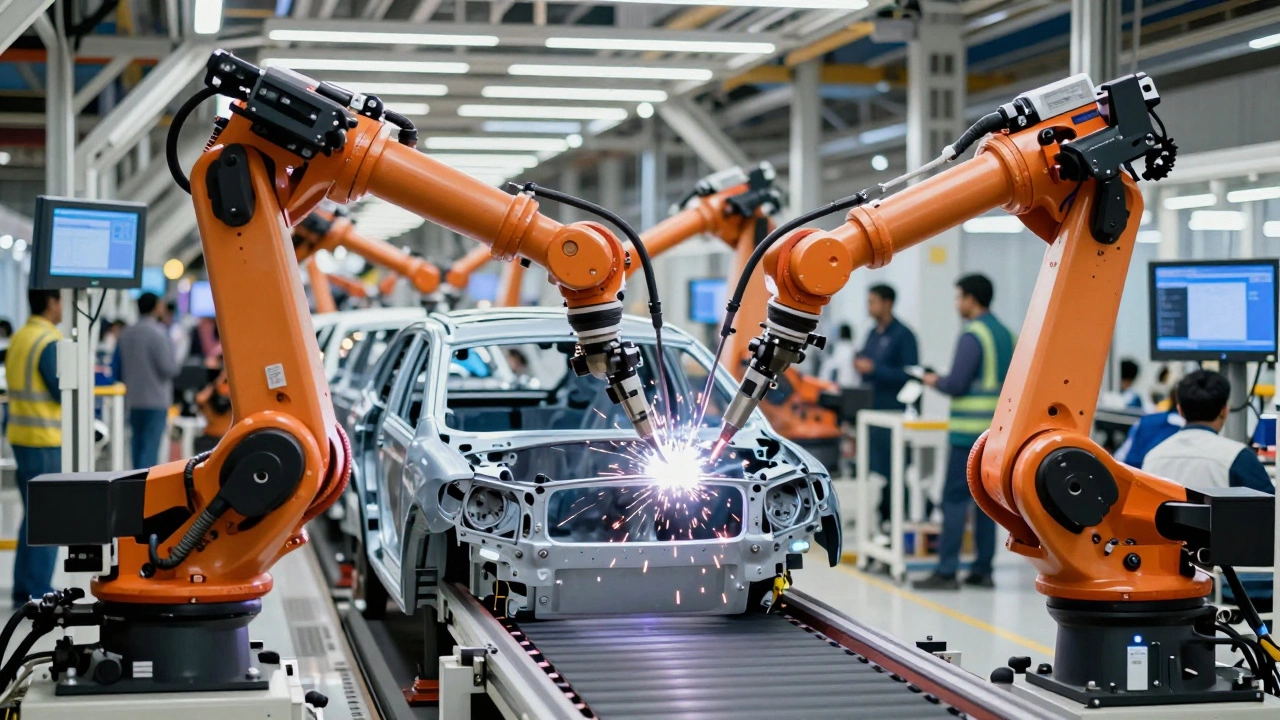
Walk into any supermarket, and you will see thousands of identical products on the shelves. From the soda cans in your hand to the smartphone in your pocket, these items share one common trait: they were not made by a single craftsman spending hours on each unit. They were produced using mass production. When people ask what the most common manufacturing system is in the world today, the answer remains surprisingly consistent despite decades of technological change. It is mass production, often referred to as flow production or continuous manufacturing.
This dominance isn't accidental. Mass production solved a critical problem for modern society: how to make high-quality goods cheaply enough for everyone to afford them. While newer methods like additive manufacturing (3D printing) get all the hype, they still account for a tiny fraction of global output. The backbone of the global economy still runs on assembly lines, standardized parts, and economies of scale.
The Core Concept: Why Mass Production Won
To understand why this system is so prevalent, we have to look at its origins. In the early 20th century, Ransom Olds and later Henry Ford revolutionized industry by introducing the moving assembly line. Before this, cars were built by skilled teams who assembled one vehicle from start to finish. It was slow and expensive. Ford’s innovation broke the process down into small, repetitive tasks. Each worker did one thing, over and over, while the product moved past them.
The result was staggering. The time it took to build a Model T dropped from 12 hours to just 93 minutes. This efficiency allowed prices to plummet, turning cars from luxury items into everyday necessities. This principle-breaking complex processes into simple, repeatable steps-is the heart of mass production. It relies on three key pillars:
- Standardization: Every part is identical. If a bolt fits one car, it fits every car.
- Dedicated Equipment: Machines are designed for one specific task, maximizing speed and precision.
- Economies of Scale: Producing millions of units spreads the cost of setup and machinery across many items, lowering the price per unit.
Today, this logic applies far beyond automobiles. Electronics, textiles, food processing, and pharmaceuticals all rely on variations of this system. Whether you are buying a shirt or a tablet, the underlying logic is the same: produce huge volumes with minimal variation to keep costs low.
Mass Production vs. Other Systems
Manufacturing isn't a one-size-fits-all field. Different industries use different approaches based on their needs. To see why mass production is the "most common," it helps to compare it with its main competitors. Here is how they stack up against each other.
| System Type | Volume | Variety | Cost Per Unit | Flexibility |
|---|---|---|---|---|
| Mass Production | Very High | Low | Very Low | Low |
| Batch Production | Medium | Medium | Medium | Medium |
| Job Shop (Custom) | Low | High | High | High |
| Additive (3D Printing) | Low to Medium | Very High | Variable | Very High |
Batch production sits in the middle. Think of a bakery making bread. They might bake 50 loaves of sourdough, then clean the ovens and bake 50 loaves of rye. It offers more variety than mass production but lacks the extreme efficiency of an assembly line. This is common in food processing and chemical manufacturing where recipes change frequently.
Job shop manufacturing is the opposite end of the spectrum. This is what you see in custom furniture making or aerospace prototyping. Each item is unique, requiring skilled labor and general-purpose machines. It is flexible but expensive and slow. You wouldn’t use job shop methods to make toothbrushes; you’d go bankrupt.
Then there is additive manufacturing, or 3D printing. While popular in tech circles, it is still niche for large-scale goods. It excels at creating complex geometries that traditional molds cannot achieve, but it is generally too slow and material-expensive for producing millions of standard widgets. For now, it complements mass production rather than replacing it.

The Evolution: Lean Manufacturing and Industry 4.0
If mass production is the king, Lean Manufacturing is its crown jewel. Originating from Toyota’s production system in Japan, Lean didn’t invent mass production; it perfected it. Traditional mass production had a flaw: it created waste. Factories would pile up inventory just in case demand spiked, leading to storage costs and obsolete stock.
Lean manufacturing flips this model. It focuses on Just-in-Time (JIT) production. Parts arrive exactly when they are needed, not days before. This reduces waste, lowers inventory costs, and improves quality because problems are spotted immediately rather than hidden in piles of finished goods. Today, almost no major manufacturer operates without Lean principles. Even companies using mass production integrate Lean to stay competitive.
Now, we are entering the era of Industry 4.0. This refers to the digital transformation of manufacturing. Sensors, artificial intelligence, and the Internet of Things (IoT) are being layered onto traditional assembly lines. Instead of humans monitoring machines, algorithms predict when a motor will fail weeks in advance. Digital twins allow engineers to simulate production changes before touching physical equipment.
Does this mean mass production is dead? No. It means mass production is getting smarter. The core structure-high volume, low variety-remains, but the execution is becoming hyper-efficient. Data drives decisions, reducing downtime and energy consumption. This hybrid approach ensures that mass production remains the dominant force even as technology evolves.
Government Schemes and Manufacturing Growth
Why does this matter to you? Because governments worldwide are pouring billions into supporting these manufacturing systems. In India, for example, the Production Linked Incentive (PLI) scheme aims to boost domestic manufacturing in sectors like electronics, automobiles, and pharmaceuticals. The goal is clear: encourage companies to set up large-scale mass production facilities locally rather than importing finished goods.
In Australia, similar initiatives exist under the Modern Manufacturing Initiative. These programs provide funding for automation, workforce training, and supply chain resilience. They recognize that while service industries dominate the GDP, manufacturing provides critical infrastructure and export revenue. By subsidizing the shift toward advanced mass production (often called "smart manufacturing"), governments hope to create jobs and reduce dependency on foreign supply chains.
For small businesses, understanding these schemes can be a game-changer. If you are looking to start a manufacturing venture, knowing whether your product fits the mass production model or requires batch customization will determine which grants and tax breaks you qualify for. Many schemes specifically target industries that can scale, reinforcing the economic importance of high-volume production.

When Mass Production Fails
Despite its dominance, mass production has blind spots. It struggles with customization. If a customer wants a blue widget instead of a red one, changing the entire assembly line is costly and disruptive. This is why we see a rise in "mass customization" strategies. Companies like Nike allow you to design your own sneakers online. Behind the scenes, they use modular mass production techniques to assemble your unique order efficiently.
Another risk is fragility. Highly optimized mass production lines are sensitive to disruptions. As seen during recent global supply chain crises, if one component stops arriving, the whole line halts. This has led many manufacturers to adopt a "China Plus One" strategy, diversifying suppliers to maintain flow. Resilience is becoming just as important as efficiency.
Environmental concerns also challenge traditional mass production. The sheer volume of output generates significant waste and carbon emissions. Sustainable manufacturing practices are now essential. This includes using recycled materials, optimizing energy usage through IoT sensors, and designing products for easier disassembly and recycling. The future of mass production isn't just about speed; it's about sustainability.
How to Choose the Right System for Your Business
If you are planning a manufacturing business, don't automatically default to mass production. Ask yourself these questions:
- What is your expected volume? If you expect to sell less than 1,000 units a year, mass production equipment may never pay for itself. Batch or job shop methods might be better.
- How much variety do you need? If your customers demand frequent changes in design or features, rigid assembly lines will frustrate you. Consider modular production or 3D printing for prototypes.
- What is your budget? Mass production requires high upfront capital for machinery and tooling. Batch production has lower entry barriers.
- Are there government incentives? Check local schemes like PLI in India or Modern Manufacturing in Australia. Some grants are only available for scaling up to mass production levels.
For most consumer goods-from clothing to electronics-mass production remains the gold standard. But for specialized industrial parts, medical devices, or luxury items, other systems offer better value. The key is aligning your production method with your market reality, not just following trends.
Is mass production the same as flow production?
Yes, they are largely synonymous. Flow production describes the continuous movement of products through the manufacturing process without interruption. Mass production emphasizes the high volume of output. Both terms refer to the same fundamental system of standardized, high-efficiency manufacturing.
Can small businesses use mass production?
It is difficult. Mass production requires significant capital investment in specialized machinery and large workforces. Small businesses typically start with batch or job shop methods. However, some small manufacturers outsource mass production to larger factories while focusing on design and marketing.
How does Lean Manufacturing differ from Mass Production?
Lean Manufacturing is a philosophy applied to mass production. Traditional mass production focused on pushing products out as fast as possible, often creating excess inventory. Lean focuses on pulling products based on actual customer demand, eliminating waste, and improving quality at every step. It makes mass production more efficient and responsive.
What role do government schemes play in manufacturing?
Government schemes like India's PLI or Australia's Modern Manufacturing Initiative provide financial incentives, tax breaks, and grants to encourage domestic production. They help offset the high costs of setting up mass production facilities, promote technological upgrades, and support workforce training, making it easier for companies to scale.
Will 3D printing replace mass production?
Unlikely in the near future. 3D printing is excellent for customization, rapid prototyping, and complex geometries, but it is currently too slow and expensive for producing millions of identical items. It serves as a complement to mass production, handling niche needs while traditional methods handle high-volume demands.